
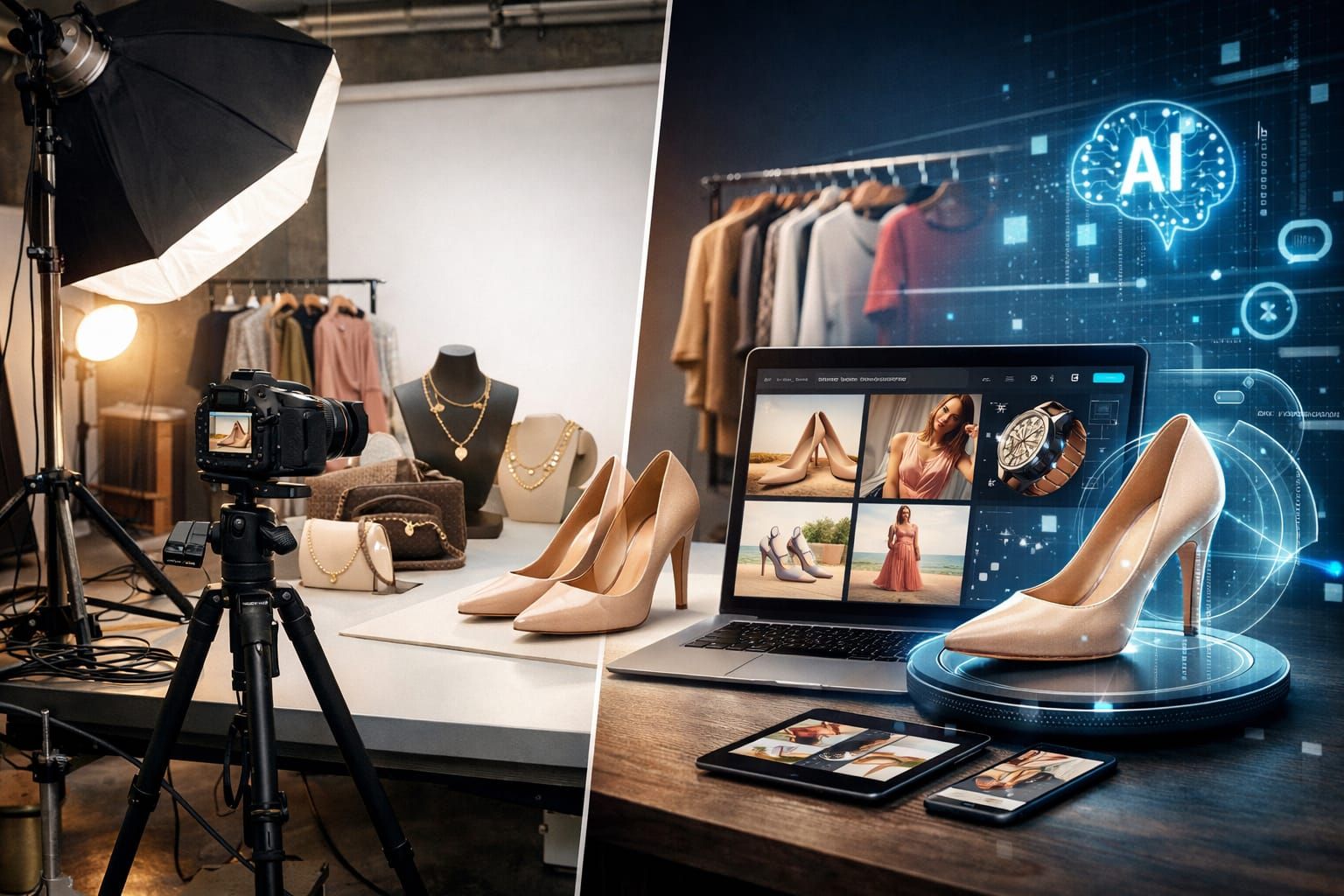
The shift toward scalable product photography
For years, ecommerce brands depended on studio-based product photography for ecommerce. Whether it was jewellery, fashion, or accessories, the process stayed the same—plan a shoot, arrange lighting, hire photographers, and wait for final edits.
That model still works, but it's slowing many brands down.
As product catalogs grow and launches happen more frequently, brands are looking for faster ways to create visuals. This is where AI product photography is starting to play a role.
Instead of repeating the same process for every product, brands are moving toward systems that help them produce images more efficiently.
The hidden limitations of traditional product shoots
Traditional ecommerce shoots come with a few challenges:
- High production costs
- Long turnaround times
- Limited flexibility after the shoot
- Difficulty maintaining consistency across products
Even small changes like a new variant, color, or angle often require a reshoot.
For brands managing multiple categories like jewellery and fashion, this becomes difficult to scale. The more products you add, the more time and cost increase.
That's why many teams are now searching for a more efficient alternative to traditional product photography.
Different products, same visual expectations
Even though products vary, customer expectations don't.
Good ecommerce product photography should always deliver:
- Clear material details and textures
- Clean lighting with natural reflections
- Accurate proportions
- Consistent visuals across the catalog
Many tools focus only on making images look “good.” But for ecommerce, clarity and consistency matter more than creativity alone.
Customers rely on images to make decisions. If visuals are inconsistent or unrealistic, trust drops.
How AI is changing product photography workflows
Instead of replacing photography completely, AI is helping brands simplify the process.
Modern AI product photography tools allow teams to:
- Create studio-style images without a physical setup
- Maintain consistency across large product catalogs
- Update visuals quickly when products change
- Generate both images and short videos from the same workflow
The focus here is practical—creating visuals that are ready for ecommerce use, not just experimental outputs.
Where AIVX fits in
This shift toward scalable visual production is where platforms like AIVX come in.
AIVX is designed for brands that manage multiple product categories—from jewellery and fashion to accessories.
Instead of treating each shoot as a one-time effort, it helps teams build a repeatable system for creating visuals.
With AIVX, brands can:
- Create clean, consistent AI product photography for ecommerce
- Generate images and short product videos in one workflow
- Maintain uniform quality across large catalogs
- Reduce dependency on studio-based shoots
If you're exploring a more scalable approach, you can see how it works here:
https://studio.aivx.in
From one-time shoots to scalable systems
The biggest change isn't just about AI—it's about how brands think.
Earlier, product shoots were one-time projects. Now, brands are moving toward ongoing systems that support:
- Frequent product launches
- Expanding catalogs
- Quick updates without starting over
This shift makes visual production more predictable and easier to manage.
What this means for ecommerce brands
Brands that adopt scalable workflows are focusing on:
- Faster turnaround without losing quality
- Consistent visuals across platforms
- Lower production overhead
- More time for creative direction and storytelling
Traditional photography will still be useful, especially for high-end campaigns. But for everyday ecommerce needs, many brands are choosing more flexible options.
Frequently asked questions
Is AI product photography better than traditional photography?
Not always. Traditional photography still works well for premium campaigns. But for large catalogs and frequent updates, AI helps improve speed and consistency.
Can AI maintain product accuracy?
Yes, when used correctly. Tools built specifically for ecommerce focus on accurate materials, lighting, and proportions rather than just visual appeal.
Is AI suitable for jewellery and fashion products?
Yes. These categories benefit from consistent lighting and presentation, which AI systems can help maintain across multiple products.
Do brands still need photo editing?
In some cases, yes. While AI reduces manual work, minor refinements may still be needed depending on the use case.
Final thoughts
AI in product photography is not about replacing creativity.
It's about removing the delays and limitations that slow brands down.
Ecommerce brands that move toward scalable systems gain more flexibility, better consistency, and faster production—without compromising quality.
If you're looking to simplify how your product images are created, exploring an AI-driven workflow like AIVX is a practical next step.
Explore more
Learn how brands are simplifying product shoots:
https://studio.aivx.in